
Repair & maintenance that keeps a roof working.
Twice-yearly inspections, moisture surveys and fast repairs — so small problems never become wet insulation and a premature re-roof.
- Inspections
- Spring + fall
- Leak finding
- Infrared + cores
- Output
- Written report
Most roofs fail at the details, not in the field
Commercial roofs rarely fail all at once. They fail at a flashing that lifted, a seam that was never probed, a drain choked with leaves, a pitch pocket that dried out, a curb someone cut into to run a new cable. Water finds that weakness, soaks the insulation and travels — often surfacing inside the building far from where it got in. By then a small repair has become wet insulation, a damaged deck and a warranty question.
A maintenance program catches these details while they are still cheap.
What a professional roof inspection covers
- Field of the roof — punctures, blisters, splits, surface wear, ponding water and debris.
- Seams and laps — probed along their length on membranes; checked for open laps on built-up and modified roofs.
- Flashings — walls, curbs, parapets, expansion joints, pipe boots and pitch pockets.
- Drainage — drains, scuppers, gutters and downspouts; strainers in place; evidence of water standing more than 48 hours.
- Edges and metal — coping, edge metal and fasteners that resist wind uplift.
- Rooftop equipment — condensate lines, curb seals, access panels and the damage trades leave behind.
- Interior — stains, drips and deck corrosion seen from below.
Every visit ends with a written report: photos, locations, priorities and costs, so owners can plan instead of react.
Finding leaks and wet insulation
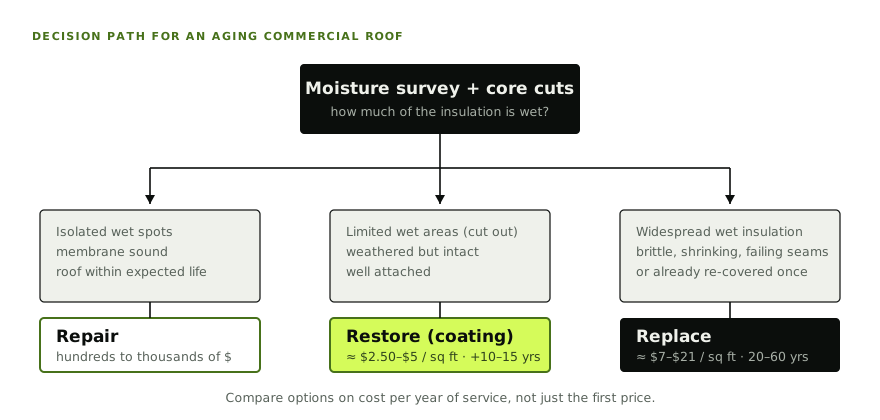
Where water entered and where it shows up are often far apart. We combine a visual survey with infrared thermography (wet insulation holds heat and shows up at night), capacitance or impedance meters and core cuts to confirm what is inside the roof. The resulting moisture map tells you how much of the roof is wet — the key number in any repair, restore or replace decision.
Repair, restore or replace
If the damage is local and the insulation dry, a targeted repair is the right answer. If the roof is aging but mostly dry, restoration — repairs plus a reinforced coating — can add a decade or more at a fraction of replacement cost. When wet insulation is widespread, the membrane is brittle or the roof has already been re-covered, replacement is usually the economical choice. Our guide Repair, restore or replace? walks through the decision.
Maintenance plans
A plan fixes the rhythm: inspections every spring and fall and after significant storms, drain and debris clearing, minor repairs done on the spot, and a running record of the roof's condition. That record is valuable in its own right — most manufacturer warranties require documented maintenance, and insurers and buyers increasingly ask for it.
Emergency leaks
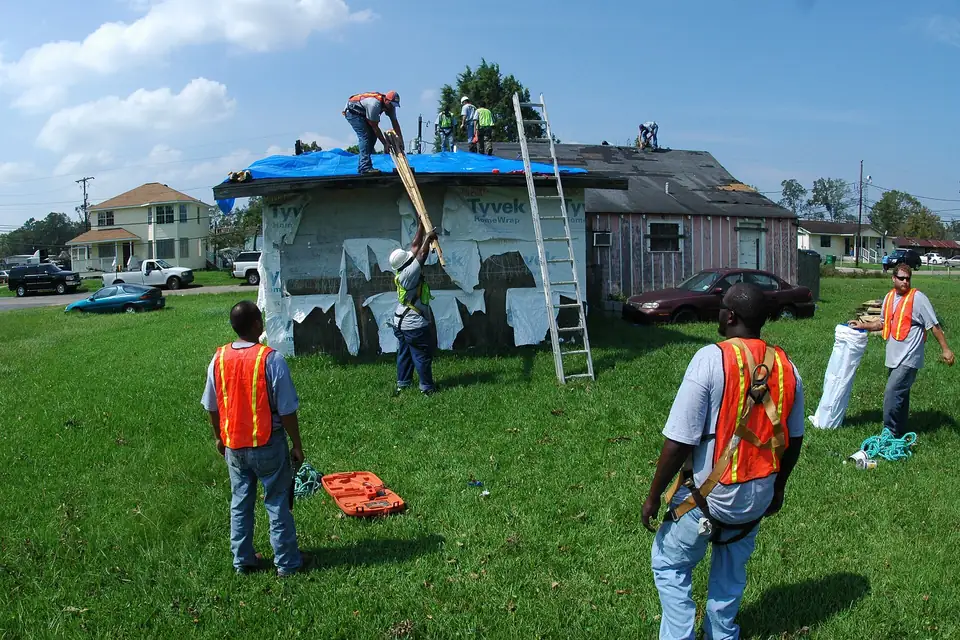
When water is coming in, the priorities are to protect people, stock and equipment, make a temporary seal, and then find the true source. Temporary repairs are exactly that; a permanent repair follows once the roof is dry and the cause is confirmed.
Repair & maintenance: common questions.
How often should a commercial roof be inspected?
Twice a year — in spring and fall — and after any major storm, hail or high-wind event. Roofs with heavy equipment, frequent trade traffic or trees nearby benefit from more frequent drain checks.
How do you find a roof leak that keeps moving?
Water often travels along the deck or insulation before it shows inside. We trace it with a visual survey of likely entry points, infrared thermography, moisture meters and core cuts — then repair the true source instead of the spot where it drips.
Does maintenance affect my roof warranty?
Usually yes. Most manufacturer warranties exclude damage from lack of maintenance, blocked drains or unauthorized alterations. Documented inspections and repairs by a qualified roofer protect the warranty — and your claim if something goes wrong.
When is a roof beyond repair?
When wet insulation is widespread, the membrane is brittle or shrinking, seams fail repeatedly, or the roof has already been re-covered once. A moisture survey puts a number on it; beyond that point, repairs cost more over a few years than a new roof.
What does a commercial roof repair cost?
Small repairs — a seam, a boot, a flashing — are typically a few hundred to a few thousand dollars. Larger repairs depend on how much wet material must be replaced. A maintenance plan spreads the cost and avoids emergency premiums.
Related systems and guides.
Is the roof leaking — or about to?
Book an inspection. You will get a written report with photos, priorities and costs, whatever you decide to do next.