
Standing seam metal for architecture with presence.
Crisp geometry, concealed fixing and controlled weathering — a roof that lasts decades and belongs to the building's architecture.
- Installed cost
- $13–$21 / sq ft
- Service life
- 40–60 years
- Min. slope
- ¼ in per ft (structural)
What standing seam roofing is
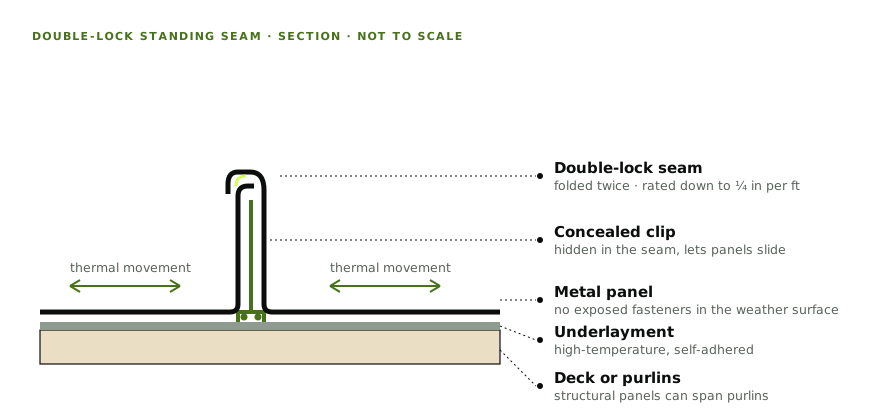
A standing seam roof is made of long metal panels that run from ridge or high point to eave, joined by raised vertical seams that stand above the drainage plane. The panels are held by concealed clips hidden inside the seams, so there are no exposed fasteners punching through the weather surface — the most common leak point on older metal roofs.
The clips also let each panel expand and contract with temperature, which matters on long commercial runs: a 100-foot steel panel can move more than half an inch between a winter night and a summer afternoon. That freedom of movement is why standing seam roofs routinely last 40 to 60 years.
Architectural vs. structural standing seam
- Architectural panels need a solid deck beneath them and a steeper slope (commonly 3:12 and up). They are chosen for appearance — crisp shadow lines on visible roofs, mansards and canopies.
- Structural panels can span between purlins without a deck and, with mechanically seamed (double-lock) seams, are approved down to ¼ in per foot. That makes metal a real option for low-slope commercial and industrial roofs, not only for pitched ones.
Materials and finishes
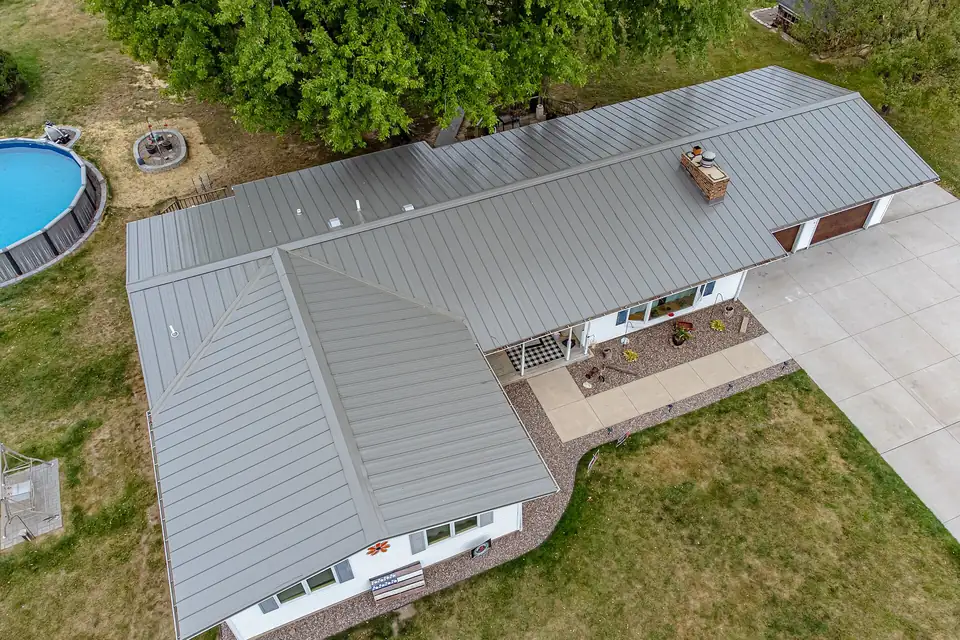
Most commercial standing seam is 24- or 22-gauge steel with a zinc-aluminum (Galvalume) coating and a PVDF (Kynar-type) paint finish that holds color for decades. Aluminum is preferred near salt water because it does not rust; zinc and copper are chosen for prestige architecture and weather to a natural patina. Light "cool" colors reflect much of the sun's energy even in darker-looking shades.
Why owners choose it
- Service life. Two membrane roofs can come and go during the life of one metal roof — which is why long-hold owners and institutions favor it on a cost-per-year basis.
- Architecture. Clean seam lines and hidden fixings let the roof read as part of the building, not as equipment on top of it.
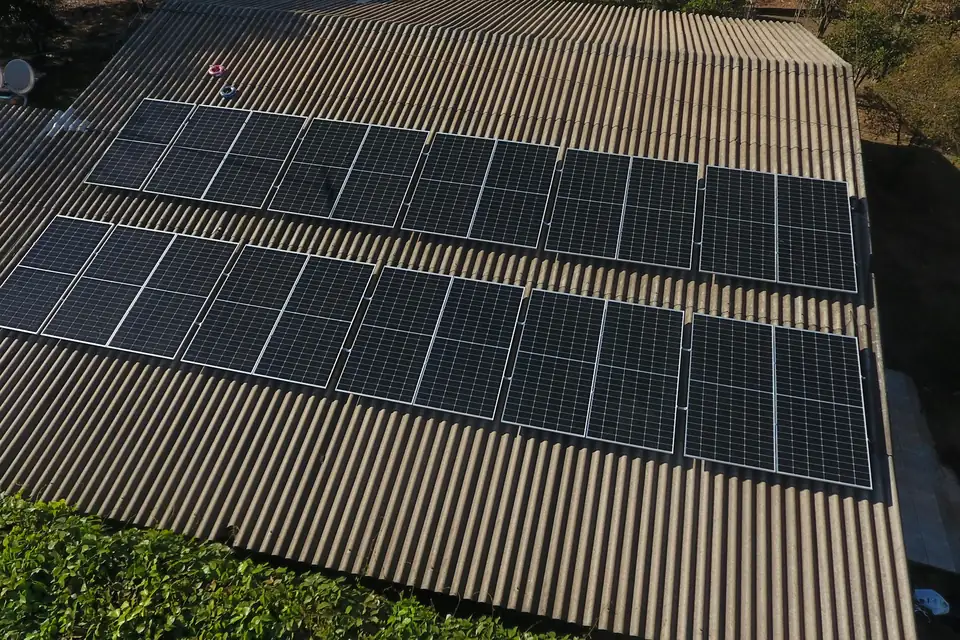
- Solar without holes. PV modules attach to the seams with non-penetrating clamps, so a solar array never compromises the weather surface. See solar roofing.
- Fire, wind and hail. Metal roofs achieve Class A fire ratings and, with the right clip spacing, high wind-uplift and impact ratings.
- Snow. Smooth panels shed snow, and snow guards control where it goes — important over entrances and walkways.
What to plan for
- Higher first cost than membranes — typically $13–$21 per sq ft installed for a replacement, depending on gauge, panel profile and complexity.
- Penetrations and rooftop units need carefully engineered curbs and diverters; metal is less forgiving of improvised details than a membrane.
- Condensation control under the panels — the right underlayment, insulation and ventilation — especially over humid interiors.
- Retrofit framing. Converting a flat roof to metal usually means a light-gauge sub-framing system to create slope, which adds cost but also room for new insulation.
Installation
Panels are often roll-formed on site to exact length, which removes end laps on long runs. The sequence: survey and structural check → shop drawings and uplift design → underlayment and insulation → clips at engineered spacing → panels and seaming → trims, closures and flashings → snow guards and walkways where needed. Most manufacturers offer weathertightness warranties of 20 years or more on top of 30-plus year finish warranties.
Maintenance
Low, but not zero: clear gutters and valleys, check sealant at trims and penetrations, remove debris that holds moisture against the panel, and inspect after hail. See our maintenance plans.
Standing seam: common questions.
How long does a standing seam metal roof last?
Typically 40–60 years for Galvalume steel with a PVDF finish, and longer for aluminum, zinc and copper. The panels themselves rarely fail; sealants, trims and details around penetrations are what need attention over time.
Can standing seam be used on a flat commercial roof?
On a truly flat roof, no — but structural standing seam with mechanically seamed (double-lock) seams is approved down to ¼ in per foot, which covers most "flat" commercial roofs. Where slope is lower, a sub-framing retrofit creates it.
Is a metal roof noisy in the rain?
Not over a commercial assembly. Insulation, a solid deck or underlayment and the ceiling below absorb most drumming. Noise is mainly an issue with bare panels over open-framed structures like sheds.
Is metal roofing worth the higher cost?
For owners who plan to hold a building for decades, usually yes: divide the installed cost by the years of service and metal often beats a membrane that will need replacing once or twice in the same period. For short holds or very large, low-visibility roofs, TPO is often the better value.
Can you put solar panels on a standing seam roof?
Yes — it is one of the best roofs for solar. Clamps grip the seams without drilling, so the array adds no penetrations and can be removed without leaving holes. See solar roofing.
Related systems and guides.
Considering a metal roof?
Tell us about the building, the slope and how long you plan to own it. We will show you where metal pays back — and where it doesn't.