"How much will the new roof cost?" is the first question every owner asks and the hardest one to answer over the phone. Two buildings with the same roof area can be priced 50% apart, and the reasons are rarely the membrane itself. This guide explains what actually drives a commercial roof replacement budget, with planning ranges you can use before you ask for bids.
Planning ranges for 2026
For a full tear-off replacement on a typical 10,000–50,000 sq ft low-slope roof, national installed costs usually fall in these ranges:
| System | Per sq ft (tear-off) | 20,000 sq ft roof |
|---|---|---|
| EPDM | $6.50–$11 | $130,000–$220,000 |
| TPO | $7–$12 | $140,000–$240,000 |
| Modified bitumen | $7.50–$12.50 | $150,000–$250,000 |
| PVC | $8.50–$14 | $170,000–$280,000 |
| Standing seam metal | $13–$21 | $260,000–$420,000 |
| Coating (restoration, no tear-off) | $2.50–$5 | $50,000–$100,000 |
These are before regional adjustment. The same TPO roof can cost roughly a third more in high-cost states than in the lowest-cost ones — see the state-by-state table on our cost calculator.
Where the money goes
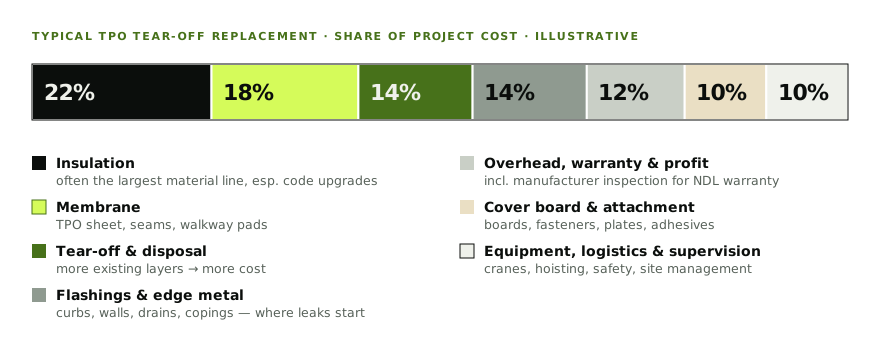
On a typical membrane replacement, the membrane itself is often less than a quarter of the price. The rest is:
- Tear-off and disposal — removing one or more old roofs down to the deck, and hauling tons of debris. Every extra layer adds cost.
- Insulation — frequently the largest single material line, especially when code requires bringing an old roof up to current levels.
- Cover board and attachment — fasteners, plates, adhesives and the board that protects the insulation.
- Flashings and metal — walls, curbs, drains, edges and copings. Labor-intensive and where quality matters most.
- Labor, equipment and logistics — crews, cranes, hoisting, safety systems, supervision.
- Overhead, insurance, warranty and profit — including manufacturer inspection fees for NDL warranties.
The seven biggest cost drivers
- Location. Commercial roofing is labor-heavy, so local wage rates dominate. Dense metros, union markets, Alaska and Hawaii sit at the top; much of the South sits at the bottom.
- Size. Mobilization is a fixed cost. A 3,000 sq ft roof can cost 25% more per square foot than a 30,000 sq ft one; very large roofs get further economies of scale.
- What is underneath. Number of existing layers, wet insulation, deck damage and — on older buildings — asbestos-containing materials. This is the most common source of change orders, which is why a pre-bid moisture survey and core cuts are worth paying for.
- Insulation requirements. Upgrading an older roof to current energy code can add $2–$4.50 per sq ft, and may require raising curbs, edges and flashings.
- Complexity. Rooftop units, curbs, pipes, drains, skylights, parapets and level changes all multiply detail work. Two roofs of the same size can differ by 25% on this alone.
- Height and access. Crane size, street closures, restricted hours and hoisting over occupied spaces all add time.
- Specification. Membrane thickness, attachment method, wind-uplift and insurance requirements, and warranty length.
Replace, re-cover or restore?
A full replacement is not always the right spend. If the existing roof is largely dry, a re-cover (one new roof over one existing roof) can save $1–$2 per sq ft. If it is dry and still watertight but aging, a restoration coating can add 10–15 years for a fraction of replacement cost. If wet insulation is widespread, replacement usually wins. Our guide Repair, restore or replace? explains how to tell.
Costs over the life of the roof
The cheapest bid is not always the cheapest roof. Compare options on cost per year of service: a $10 per sq ft membrane lasting 20 years and a $17 metal roof lasting 50 years are very different investments. Add energy — a reflective surface and code-level insulation cut heating and cooling costs every year — and maintenance, which is what keeps a roof reaching its rated life at all.
How to budget before bidding
- Get a calculator estimate for your system, state and size.
- Commission a condition survey with core cuts and a moisture scan, so every bidder prices the same known conditions.
- Carry a contingency of 10–15% for hidden conditions on tear-off projects.
- Ask bidders to price like for like: same assembly, insulation, thickness, attachment and warranty.
- Check what is excluded — rooftop unit disconnects, permits, deck repair unit prices.
Ready to turn a range into a number? Send us the basics and we will scope the survey.