
TPO roofing for large flat roofs.
A heat-welded, reflective single-ply membrane built for scale, service access and dependable daily performance.
- Installed cost
- $7–$12 / sq ft
- Service life
- 20–30 years
- Best for
- Low-slope, large area
What TPO roofing is
TPO (thermoplastic polyolefin) is a single-ply roofing membrane made from a polypropylene and ethylene-propylene blend, reinforced with a polyester scrim and supplied in wide rolls — commonly 45, 60 or 80 mils thick. Its defining feature is that the seams are heat-welded: hot air fuses overlapping sheets into one continuous, monolithic surface that is stronger at the seam than a taped or glued joint.
Most TPO is white and highly reflective, which is why it became the default roof for warehouses, big-box retail and light industrial buildings: it is light, installs fast over very large areas and keeps the roof surface far cooler than a dark roof in summer.
How a TPO roof is built
A TPO roof is a system, not just a membrane. From the deck up, a typical assembly is:
- Deck — steel, concrete, wood or gypsum, checked for corrosion, deflection and fastener pull-out.
- Vapor retarder where interior humidity or climate calls for one (cold storage, pools, food processing, cold climates).
- Insulation — usually polyiso boards in two staggered layers, often with tapered insulation to create slope to drains.
- Cover board — a thin gypsum or high-density board that protects insulation from foot traffic and hail and gives the membrane a firm base.
- Membrane — attached in one of three ways: mechanically attached (fastened in the seams — fast and economical), fully adhered (glued — quieter in wind, smoother, better on complex roofs) or induction welded (plates fastened through the insulation and welded to the membrane from above, no penetrations through the sheet).
- Flashings and edge metal at curbs, walls, drains and perimeter — where most roofs actually leak, and where most of the craft goes.
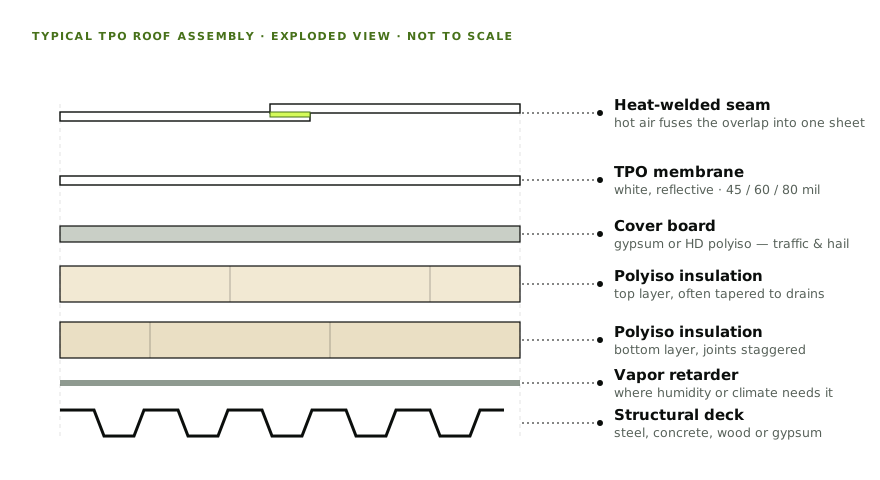
The attachment method and fastener pattern are set by the wind uplift the roof must resist, which depends on the building height, exposure, location and — often — the owner's insurer.
Where TPO works best
- Large low-slope roofs from about 10,000 to well over 500,000 sq ft, where speed and material cost matter most.
- Warm and mixed climates, where a reflective membrane cuts cooling load — see cool roofing.
- Buildings that will carry rooftop solar: a new, white, heat-welded roof is an ideal base for ballasted or attached PV racking.
- Re-roofs over an existing dry roof, where a lightweight re-cover avoids a full tear-off.
Where to think twice
- Grease, oils and chemicals. Restaurant exhaust, animal fats and many industrial exhausts attack TPO over time. PVC or KEE membranes resist them better — see industrial roofing.
- Heavy roof traffic. Membranes puncture. Walkway pads to and around equipment are not optional.
- Extreme heat and UV. In the hottest climates we specify 80-mil sheets for a thicker weathering layer above the scrim.
- Visible roofs. A membrane is functional, not architectural. Where the roof is part of the facade, standing seam metal usually serves the building better.
Installation, step by step
A replacement typically runs: roof survey and core cuts → design and wind-uplift calculation → submittals and manufacturer approval → tear-off or preparation in sections that are made watertight every night → insulation and cover board → membrane and seams → flashings, edge metal and walkway pads → seam probing, manufacturer inspection and warranty. On an occupied building we phase the work around operations and keep interiors protected throughout.
Warranty and maintenance
Manufacturers offer system warranties of 15 to 30 years, and the best of them are no-dollar-limit (NDL) warranties that cover labor and materials for leaks caused by the system. They come with conditions: an approved installer, a manufacturer inspection at completion, and documented maintenance. We recommend a walk-through each spring and fall and after major storms — clearing drains, checking seams and flashings, and fixing small issues before they become wet insulation. Read more in repair & maintenance.
What drives TPO cost
Membrane thickness and attachment method, how many layers must be torn off, how much insulation the energy code now requires, the number of curbs and penetrations, access and crane time, and — above all — the roof size and local labor market. As a national planning figure, a tear-off TPO replacement lands around $7–$12 per sq ft; new construction and simple re-covers come in lower. Price your own roof with the cost calculator.
TPO roofing: common questions.
How long does a TPO roof last?
A well-installed, maintained TPO roof typically lasts 20–30 years. Thicker membranes (60 or 80 mil), good drainage, a cover board and twice-yearly inspections push it toward the top of that range; ponding water, roof traffic and neglected flashings pull it down.
Is TPO better than EPDM?
For most commercial roofs in warm and mixed climates, yes: TPO seams are heat-welded rather than taped, and the white surface is reflective. EPDM still makes sense in cold climates, on roofs that value flexibility and proven long-term track record, and where budget is the main driver. Our guide TPO vs PVC vs EPDM compares them in detail.
Can TPO be installed over an existing roof?
Usually once, if the existing roof is dry and well attached. We confirm with core cuts and a moisture survey; any wet insulation is removed. A re-cover saves tear-off cost, but adds weight and is not allowed over a roof that has already been re-covered.
Should I choose 60-mil or 80-mil TPO?
60 mil is the commercial standard. 80 mil adds weathering thickness above the reinforcement and more puncture resistance — worth it in very hot, high-UV climates, on roofs with frequent service traffic, and when you want the longest warranty terms.
How much does TPO roofing cost per square foot?
As a national planning range, $7–$12 per sq ft for a tear-off replacement, less for new construction or a simple re-cover. Size, access, insulation upgrades, rooftop equipment and your local labor market move the number; the calculator accounts for them.
Does a white TPO roof reduce energy bills?
In warm climates, yes — a reflective roof can run tens of degrees cooler than a dark roof on a sunny day, lowering cooling load, especially on single-story buildings with large roofs. In cold climates the benefit is smaller and insulation matters more. See cool roofing.
Related systems and guides.
Planning a TPO roof?
Share the roof size, age and any leak history. We will confirm what can stay, what must go and what the right membrane build-up is.