
Retail roofing without closing the doors.
Architectural presence and visitor comfort without unnecessary energy loss — delivered around opening hours and tenants.
- Go-to system
- TPO / PVC
- Facades
- Standing seam
- Constraint
- Open stores
Open for business during the work
Retail roofs sit over sales floors, customers and tenants who are paying rent to trade — not to put up with dust, noise, odors and drips. Shopping centers add a layer of complexity: dozens of tenants, each with their own HVAC units, signs and opening hours, all under one roof owned by a landlord who needs the project done once and done right.
Systems that fit
- TPO — the standard for big-box and strip-center roofs: reflective, fast and economical.
- PVC — over restaurants and food courts, where kitchen exhaust grease attacks TPO and EPDM.
- Standing seam metal — for mansards, towers, canopies and entrance features, where the roof is part of the storefront and the brand.
- Cool roofs and coatings — single-story retail has a lot of roof per square foot of sales floor, which makes roof reflectance and insulation matter to energy bills.
How we keep stores trading
- Scheduling around opening hours, holiday peaks and tenant events — including night and early-morning work where noise matters.
- Odor and fume control. Low-odor adhesives and mechanically attached or induction-welded systems avoid fumes being pulled into rooftop air intakes. Where adhesives are needed, intakes are coordinated with the HVAC contractor.
- Tenant communication. Notices, schedules and a single point of contact for store managers.
- Safe public areas. Protected entrances, controlled material hoisting and no work above open walkways.
Rooftop equipment
A typical strip center carries a rooftop unit for every tenant, plus exhaust fans, refrigeration and signs. Every curb and penetration is a flashing to get right and a trade that will walk on the roof later. We coordinate disconnects and reconnections with the tenants' HVAC contractors, raise curbs where new insulation requires it, and add walkway pads to every unit.
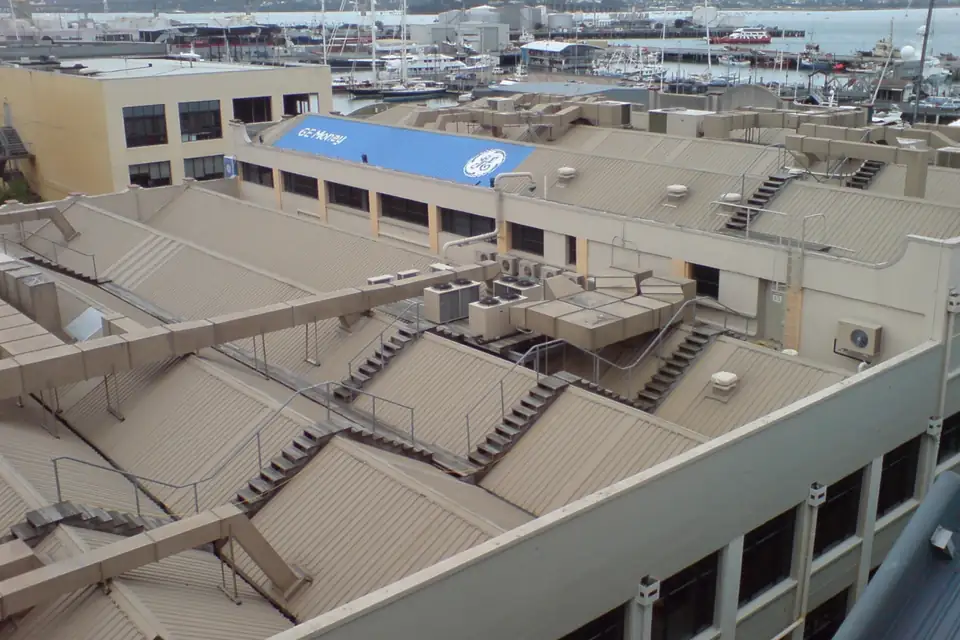
Landlord planning
For multi-building portfolios we survey each roof, rank them by condition and risk, and build a multi-year capital plan that mixes repairs, restorations and replacements — so budgets are predictable and no roof fails by surprise. See repair & maintenance.
Retail roofing: common questions.
Can a store stay open while the roof is replaced?
Yes — that is the norm. Work is phased, scheduled around trading hours, and dried in daily. Low-odor attachment methods and coordination of rooftop air intakes keep fumes out of the store.
Why use PVC over restaurants?
Kitchen exhaust carries fats and oils that degrade TPO and EPDM over time. PVC and KEE membranes resist them, and grease containment at exhaust fans protects any roof.
Who handles the rooftop HVAC units during a re-roof?
We coordinate with the tenants' or landlord's HVAC contractors to disconnect, raise curbs if needed, and reconnect units — scheduled so no store loses cooling for long.
How do landlords budget roofs across a portfolio?
With a condition survey of every roof, ranked by risk and remaining life, turned into a multi-year plan that mixes repairs, restorations and replacements. It turns roofs from surprises into a predictable line item.
Systems and guides for retail roofs.
Planning work on a retail roof?
Tell us about the center, the tenants and the timing. We will propose a phasing plan that keeps doors open.