An aging commercial roof leaves owners with three choices: keep repairing it, restore it, or replace it. Choose too early and you throw away years of service. Choose too late and water spreads through the insulation, the deck corrodes and a manageable project becomes an emergency. The good news is that the decision can be made on evidence rather than guesswork.
Step 1: find out what is inside the roof
The surface tells you less than you think. The deciding factor is almost always moisture in the insulation, because wet insulation loses its thermal value, adds weight, feeds corrosion and cannot be dried in place. Three tools reveal it:
- Infrared thermography — after a sunny day, wet areas hold heat and glow at night on a thermal camera.
- Capacitance or impedance meters — a grid of readings across the roof maps moisture.
- Core cuts — small samples that confirm the readings and show how many layers there are and what they are made of.
The result is a moisture map with a number attached: what percentage of the roof is wet.
Step 2: match the evidence to the option
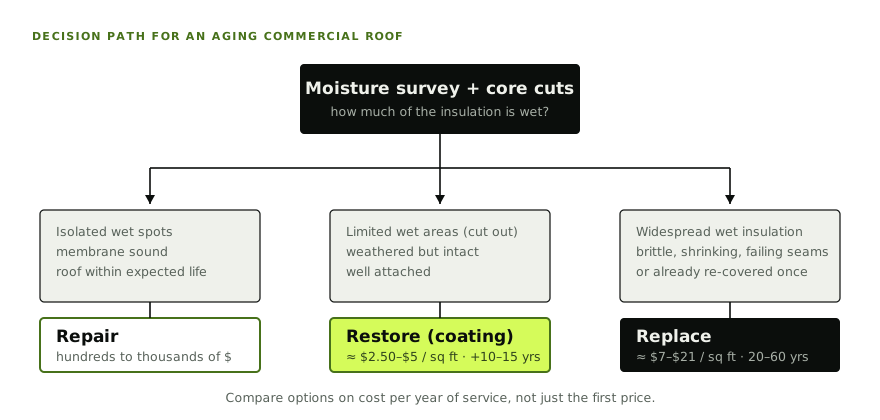
| Repair | Restore | Replace | |
|---|---|---|---|
| Wet insulation | Isolated spots | Limited — typically under a quarter of the roof, cut out and replaced | Widespread |
| Membrane condition | Sound, local damage | Weathered but intact and well attached | Brittle, shrinking, splitting or failing seams |
| Previous re-covers | Any | Depends on system | Already re-covered once |
| Typical cost | Hundreds to thousands of dollars | ~$2.50–$5 / sq ft | ~$7–$21 / sq ft |
| Adds | Buys time | 10–15 years, renewable | 20–60 years |
When repair is enough
If the roof is within its expected life, the insulation is dry and the problems are local — a punctured area, a failed boot, a lifted flashing, a clogged drain — repair is the right answer. Pair it with a maintenance plan: most "old roof" problems are really neglected-detail problems.
Warning sign: if you are calling for the same kind of leak every season, or repair invoices add up to more than 10–15% of replacement cost within a couple of years, you are past the repair stage.
When restoration makes sense
Restoration means repairing everything that needs it, replacing wet areas, reinforcing seams and flashings, and applying a fluid-applied coating over the whole roof. It works when the roof is still largely dry and structurally sound, but weathered. The benefits:
- A fraction of the cost of replacement, with no tear-off and far less disruption to the building.
- A reflective surface that lowers roof temperature and cooling load — see cool roofing.
- Often renewable: at the end of its term, a coated roof can be cleaned and recoated.
- Depending on the jurisdiction and accounting treatment, restoration may be treated as maintenance rather than a capital replacement — ask your tax advisor.
Restoration is not a way to hide a failing roof. Coating over saturated insulation traps water and makes the eventual replacement more expensive.
When replacement is the right call
- Wet insulation is widespread across the roof.
- The membrane has reached the end of its life: brittle, cracking, shrinking at the edges, or seams failing repeatedly.
- The deck is corroded or damaged.
- The roof has already been re-covered, so another layer is not allowed.
- You want to change something fundamental: add insulation to current code, correct drainage, prepare for solar, or move to a longer-life system like standing seam metal.
Replacement is also the moment to fix the roof's design problems — ponding water, undersized drains, poor access to equipment — rather than rebuild them.
Think in cost per year
Divide each option's cost by the years it realistically buys. A $4 per sq ft restoration that adds 12 years costs about $0.33 per sq ft per year; a $10 replacement that lasts 25 years costs $0.40. Add energy savings, disruption to the business and the risk of damage to stock and interiors, and the answer is usually clear. The cost calculator lets you compare restoration and replacement for your roof size and state.
Next step
Every good decision starts with a survey. Request an inspection and you will get a moisture map, photos and a recommendation you can act on — whether that is a $500 repair or a new roof.